
Executive Summary
Sydney YIMBY has reviewed the draft Edgecliff-Woollahra precinct proposal, and is pleased to provide comments on the planning proposal to the NSW Government. Fundamentally, we are supportive of the proposal, and urge the NSW Government to deliver the rezoning as soon as practicable.
Sydney is undeniably in a housing crisis. The roots of this crisis run deep, and it is a crisis that has been decades in the making, and we know it can’t be resolved with a single project, an easy change to legislation, or one rezoning. There is no silver bullet that will solve the housing crisis. Enabling building more homes is not the only thing we need to do, but it is the most important thing we can do. Every bit of effort helps, and the contributions must be made across our city. Housing needs to be delivered for the benefit of everyone, and this means accounting for people who do not even know they might live in Woollahra some day
The rezoning proposal by the state government is one such contribution. It is regrettable that Woollahra Municipal Council continues its long-running stance against the provision of much-needed housing in its council area. As such, it is essential that this rezoning proposal be delivered in its current form, or be even more ambitious, over Woollahra Council’s objections and those of a self-selected group of people opposed to the rezoning.
We have a number of recommendations to improve the proposal, but these are refinements, and we consider they can readily be incorporated into the proposal.
Key recommendations
Recommendation 1: Ensure flexibility is provided to ensure that assembly and delivery of the key sites identified in the rezoning plan, helping to ensure the overall goals are met.
Recommendation 2: Any redistribution of housing must deliver the same number of units, and must consider site feasibility and the impact on the process.
Recommendation 3: Ensure that dwelling mix limits are applied only as a guideline, with protections to ensure that a sufficient number of dwellings are delivered (if such a control is necessary).
Recommendation 4: Eliminate, or significantly relax the floor space ratio (FSR) limits across the rezoned area.
Recommendation 5: Embed the principle of allocating road user space based on the NSW Road User Space Allocation Policy, and ensure roadside parking costs are appropriately charged to users.
Additional recommendations
The following additional recommendations should be noted as well:
Ensure Woollahra station is delivered as promised by the state government.
Explore the conversion of traffic and parking lanes into active transport or public transport lanes, in particular on Edgecliff Rd and Queen St.
Prioritise the kerb space being used for public and active transport, and accessible parking and loading zones to support access to those who need it most.
Our comments on the proposal’s details
Sydney YIMBY is broadly supportive of the proposal, and rejects suggestions that this rezoning is excessive. We would oppose any watering down of the targeted densification presented in the proposal, and categorically reject Woollahra Municipal Council’s proposed alternative, as it provides far too little uplift. Woollahra’s alternative plan would deliver at most 3,600 dwellings, which we consider insufficient.
Nonetheless, we have some criticisms of the proposal as written, and recommendations we consider would result in a stronger rezoning.
Key Sites
The creation of key sites that are contingent on significant land assemblies will create challenging conditions to deliver. Sydney YIMBY generally supports broader-based planning controls that enable the delivery of housing that meets the needs of the moment.
In contrast, the key sites approach requires planners to predict the future. We contend that no-one, not even the incredibly skilled planners at the Department of Planning, Housing and Infrastructure (DPHI) possess a crystal ball that allows them to see the future. One option would be the ability to transfer capacity between sites (whether between key sites or with other locations in the area), or to have uplift contingent on achieving a certain amount of land area, rather than specific sites. There may be other ways of achieving the same outcome.
Recommendation 1: Ensure flexibility is provided to ensure that assembly and delivery of the key sites identified in the rezoning plan, helping to ensure the overall goals are met.
Distribution of new housing across the rezoned area
Sydney YIMBY would not oppose refinements to reflect local feedback, including shifting where within the rezoned area the housing uplift will be delivered. However, if any redistribution occurs, we would expect the following as a baseline:
At least the same dwelling count is delivered across the rezoned area
That sites are not rendered infeasible by being too tightly constrained
That any changes to the controls are made expeditiously, and do not unduly delay the rezoning process.
For example, there may be scope to increase the heights nearer to Bondi Junction, in exchange for slightly lower building heights in Woollahra. But any refinements must be delivered quickly. The longer there are delays in the process, the longer the housing crisis drags on.
Recommendation 2: Any redistribution of housing must deliver the same number of units, and must consider site feasibility and the impact on the process.
Dwelling mix
Enforcing limits on dwelling mixes at a per-project level is likely to be counterproductive. We suggest they should be loosened, or only applied as a precinct target. Sydney YIMBY generally opposes setting dwelling mix caps, recognising that project delivery is the best stage to determine an appropriate dwelling mix.
Generally, if one dwelling type is more profitable than others, that is indicative of a shortage in the area. Artificially constraining their production raises the cost of housing across the board. If studios and one-bedroom apartments are what the market demands, we should facilitate that. And likewise for 3 (or more) bedroom units.
Sydney’s housing market is integrated and linked. More 3-bedroom units in Woollahra draws demand from elsewhere, and frees up more affordable housing elsewhere. This is the real benefit of new housing more generally, not the new units themselves. This has been shown empirically in Australian, and an abundance of overseas evidence. Focusing on the housing that is being newly built ignores this, and placing too-strict limits on the mix risks damaging supply for no good end.
Recommendation 3: Ensure that dwelling mix limits are applied only as a guideline, with protections to ensure that a sufficient number of dwellings are delivered (if such a control is necessary).
Floor space ratio (FSR) controls
We consider that the FSR controls that are proposed are far too restrictive, though acknowledge this is common practice in NSW. Sydney YIMBY considers Floor Space Ratio to be overused as a development control in NSW, and urges its use to be reduced. Many of the most prized buildings in Sydney’s inner city (for example in Potts Point or Elizabeth Bay) are in gross violation of current FSR restrictions.
With land assembly already likely to be a challenge in this precinct, we need to make the most of each site that does proceed. The FSR controls are far out of proportion with the height limits, and place a serious restriction on the amount of housing that could be delivered. For example, there are several sites, with height limits at or close to 100m and FSRs substantially below 4. We understand that this is intended to protect open space on the sites, but the best way to deliver this is to require it directly, rather than imposing an additional control. In our view, setbacks and other direct built envelope controls are far more effective at achieving the desired urban form outcomes than FSRs.
Melbourne does not generally impose FSR controls, and this is a substantial reason why they have outbuilt us for decades. While the best way to abolish FSR was to have never introduced it, the second best way is to abolish or substantially relax them now, starting with this proposal.
Recommendation 4: Eliminate, or significantly relax the FSR limits across the rezoned area.
Embed good kerb space allocation practices
The area will be going through significant densification over the next two decades as a result of this plan, without the creation of additional road or street space. As such, it is critical that road and kerb space is properly valued and is used for the highest value use, not based merely on existing rights. Furthermore, this is an area with good (and improving) public transport, and good active transport (see Transport infrastructure below).
It is essential that the use of precious kerb space for storage of stationary private vehicles should be the last option chosen for this space, except where no higher value uses are needed. The NSW Movement and Place Framework guidance should be applied with a view to achieving this.
Existing kerb uses should be continually reevaluated to ensure they are the highest value in accordance with the Road User Space Allocation Policy. Where private motor vehicle parking is provided at the kerb, it should be priced to ensure that the user pays appropriately.
Recommendation 5: Embed the principle of allocating road user space based on the NSW Road User Space Allocation Policy, and ensure roadside parking costs are appropriately charged to users.
Our comments on the proposal’s concept
Location
Woollahra is the perfect location to build more housing. This applies to both the LGA and the area proposed to be rezoned. It is:
Close to the Sydney CBD, within 20 mins by train or bike.
Soon to be home to a new train station (and the area to be rezoned is within the walk shed of two other stations, Edgecliff and Bondi Junction).
Close to significant local and regional amenities, including Centennial Park and other parks, the harbour and beaches.
Sydney YIMBY acknowledges that the existing density of the area to be rezoned is high by Sydney standards, however the two SA2s that cover the rezoned area are the 39th (Double Bay - Darling Point, 9960 pp/km²) and 50th (Woollahra, 7450 pp/km²) densest SA2s in the Sydney GCCSA. This is to be expected, as many well located areas are already dense. Sydney YIMBY contends that this is not a reason not to proceed.
By global standards these areas are not particularly dense, and more residents can be accommodated. Furthermore, as noted below, there are many areas of Sydney that are expected to become more dense over the coming decades, and there is nothing particularly unique about Woollahra that would prevent it from also densifying further.
Topography
It is undeniable that Woollahra is hilly, and even steep. However this is true of much of Sydney, especially in the east. The notion that Sydney cannot build at higher densities on slopes is belied by places such as Potts Point, Elizabeth Bay and the Lower North Shore.
We are not geotechnical experts, and neither are many who have claimed building towers in the area is not possible. Whether a development needs to be shortened for geotechnical reasons, that is a question for that project, not this stage. In fact, if it’s so unsuitable as is claimed, then the opponents of rezoning have nothing to fear, as nothing more will be built.
It should not be the role of the planning system to do free work for the development industry. The planning system should zone to provide capacity in an area, and the construction industry can use their expertise to determine what can be delivered in that area.
Transport infrastructure
Many complaints about the rezoning have focused on the impact on car drivers and their passengers. We reject this framing as being far too narrowly focused. As has been noted many times, including here in Sydney, private cars are the least space-efficient mode of transport available. We should prioritise modes of transport that provide the greatest level of mobility for the space available. These are trains, buses, bikes and walking. The use of precious kerb space for the storage of private cars is an immense wealth transfer from the public to those able to secure it. For road space, buses, bikes and walking all move far more people in a given space.
Transport for NSW’s Road User Space Allocation Policy and the NSW Movement and Place Framework are clear that space priority should be diverted away from cars, especially in dense environments with good public and active transport, which Woollahra absolutely fits.
Public transport
Perhaps the most critical enabler of this rezoning is the delivery of Woollahra train station. Much of the area to be rezoned will be within the walkshed of Edgecliff or Bondi Junction, but it is essential that Woollahra station is delivered to enable the rezoning to deliver its full promise. This is not a reason to delay the rezoning, but a reminder that it is critical to deliver this infrastructure.
The soon to be opened Woollahra train station, Edgecliff, and Bondi Junction stations are all situated on the T4 train line. The state government’s own figures show that the peak utilisation of the T4 train line is 43% in the AM peak, indicating enormous capacity is still available, absent any upgrades to rail capacity.
There are frequent bus routes travelling through and near the rezoned area. This provides a significant choice of mode for public transport, and enables access to other areas away from train lines.
If targeted improvements to public transport service levels and infrastructure are needed (such as at Edgecliff and Bondi Junction stations), then this is an obvious choice. Avoiding rezoning would mean all of Sydney pays higher housing costs to avoid upgrades. Likewise, the conversion of general traffic lanes to bus lanes is an obvious solution to bus capacity issues at the street level.
Active transport and parking spaces
The Transport Management and Access Plan notes that Randwick to the south and most of the CBD is within a 15 minute bike ride of the rezoned area.
As has already been seen in the City of Sydney, and in particular Oxford Street West, the provision of cycling infrastructure has resulted in a cycling boom. This has been reinforced by the ready availability of e-bikes, which have rendered Sydney’s hilliness a non-issue. In particular, shared e-bikes (such as Lime) have made e-bikes readily accessible to residents of Sydney for both occasional and frequent users for routine and casual rides. This popularity has seen more than 3.7 million shared bike trips in the City of Sydney in 2025. Furthermore, between 6 and 12 such bikes can be parked in a single car space, providing much greater access to mobility for more people in the same footprint.
Active transport such as cycling results in a healthier population overall. Multiple studies have shown that populations that ride bikes more frequently have better health outcomes overall, even when accounting for higher accident injury rates.
Any suggestion that active transport infrastructure such as dedicated cycleways results in negative emergency response has been disproven time and time again. In fact, a well-designed cycleway can fulfill a secondary function as an emergency pathway. When an emergency vehicle needs to get by, a bike rider can simply maneuver out of the way, allowing an ambulance or fire vehicle access. A car driver cannot pick their car up and move it out of the way.
As such Sydney YIMBY urges the delivery of separated bike infrastructure along key routes in the rezoned area to provide this double duty. Edgecliff Road and Queen Street are obvious candidates for fully separated cycleways. Additionally, kerb space should be prioritised for the storage of shared mobility devices (as seen in the City of Sydney program to convert road space into shared bike parking spaces).
If this requires on-street parking to be eliminated to achieve the delivery of this infrastructure, then it should be eliminated. We acknowledge that not all people are able to ride a bike, and so where such disabled access or loading zones are needed, they should be prioritised over general parking places. Any remaining parking places should be charged at an appropriate rate to ensure that the user pays.
Schools
Woollahra is an area that has been ageing rapidly (see Demographics below). Public primary school enrolments have been dropping across Sydney’s eastern suburbs since peaking around 2019. It is likely that something similar will happen for secondary schools, as the pool of school students age through the system. As such, far from presenting a crisis, building additional housing over the next 20 years that will likely include families will be able to take advantage of the space that is not currently filled in local schools.
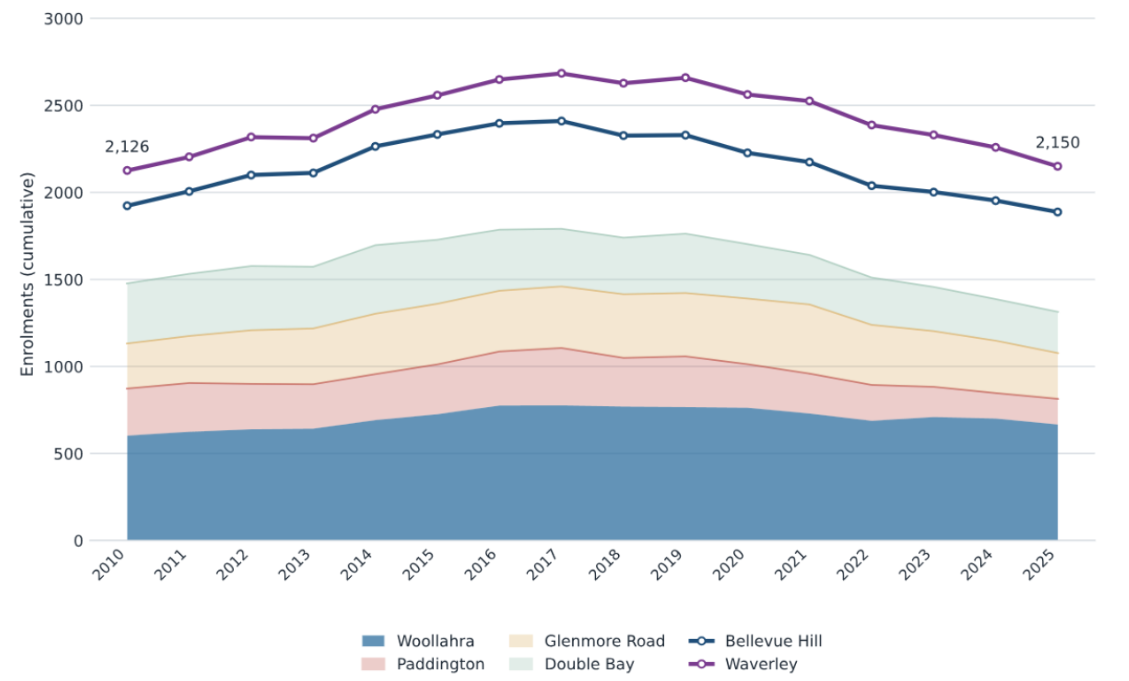
Sydney YIMBY’s analysis of data from ACARA shows that primary school enrolment in and around the area to be rezoned peaked in 2017 (see figure 1). Since then, enrolments have decreased by between 15 and 25%, and have returned to levels last seen 15 years ago. Given that Woollahra’s population continues to age faster than the population of Sydney more widely, without change the demand for schools is likely to continue to decline.
Figure 1: Primary school enrolments for Woollahra public school, and the next nearest five public primary schools (Data source:ACARA)
Far from overwhelming the schools in the area, this rezoning proposal may in fact reduce the pressure to downsize or even close them. In the longer term, if additional capacity is needed, this can be delivered, as noted in the Social and Community Infrastructure Assessment.
Open space
Sydney YIMBY notes that many of the key sites have public open space requirements, which will result in the creation of additional space for residents of the area, as well as visitors. We support the provision of open space where it is needed, however we also note that open space in Sydney is frequently underused. Within a short walk or bike ride of the rezoned area is:
Trumper Park
Cooper Park
Rushcutters Bay Park
Centennial Park
In discussions regarding open space, Sydney YIMBY has heard some ludicrous figures for the amount of open space required, including that “a new Centennial Park” of open space is necessary. This is patently absurd, as it represents around 210 m² per new dwelling, close to the size of a regulation tennis court of open space for each dwelling.
Public open space is a critical public good, but using it as a means to prevent housing delivery is perverse. The homeless population in Woollahra has grown over the past decade (as it has elsewhere), which suggests that we have focused insufficiently on delivering housing that meets the needs of the population.
Comparable rezonings
The proposal adds (at most) 9400 dwellings in 168 hectares. This is an additional 56 dwellings per hectare (dw/ha). If all were delivered, the two suburbs of Edgecliff and Woollahra would have a dwelling density of 93 dw/ha. At present densities, this is lower than Elizabeth Bay (145 dw/ha), Wentworth Point (117 dw/ha), Rushcutters Bay (103 dw/ha) and Chippendale (97 dw/ha).
The scale of this rezoning is proportional to other rezoning efforts in Sydney. For example, Sydney YIMBY has analysed data available on the following rezonings to demonstrate this:
Areas with existing housing:
Westmead South is being rezoned for an additional 13,000 new homes in 125 ha (an additional 104 dw/ha).
Mosman proposes to deliver 4,700 dwellings over approximately 80 ha (an additional 59 dw/ha).
Burwood North is proposed to provide 18,300 new dwellings in 113 ha (an additional 162 dw/ha).
Cherrybrook has been rezoned for around 10,000 new dwellings on 48 ha (an additional 208 dw/ha).
Greenfield or brownfield rezoning:
Bays West will deliver 8,500 homes in 77 ha (an additional 110 dw/ha).
Bradfield will deliver 10,000 homes in 115 ha (an additional 87 dw/ha).
Inner West Council’s Our Fairer Future is more complex, however it is slated to deliver 27,000 new dwellings and a rezoning along Parramatta Rd may deliver a further 8,000 dwellings. At the time of writing, a new plan (Our Fairer Future 2) is under development, which is intended to deliver a more broad-based capacity uplift across Inner West Council.
Thus, Sydney YIMBY must conclude that this rezoning is proportionate, and Woollahra Council’s assertions that it is being “punished” are entirely spurious and should be dismissed as such. Indeed, with the exception of Bays West, all of these rezonings are substantially further from the Sydney CBD, which provides the greatest job density in Australia, not just Sydney.
Economics
For too long feasibility has been relegated to an irrelevance in rezoning discussions. This lies at the heart of Sydney’s decades-long worsening housing affordability. The economics literature is clear. The main pathway to durable housing affordability is to build more housing. There are other things that can be done, but this is the most important.
The NSW Productivity and Equality Commission’s recent report Building more homes where the numbers stack up and the accompanying Centre for International Economics (The CIE) report Cost and feasibility estimates for supplying new dwellings in New South Wales are clear. The Eastern Suburbs of Sydney are the most feasible area to build new apartments in Sydney.
As these reports note, in a system where the vast majority of housing is delivered privately (which has been true in Australia since WWII), feasibility of construction is a key determinant of whether dwellings proceed to delivery.
By permitting more housing where it is feasible, more housing can be delivered. Until recently, the development of high-rise apartments has been effectively prohibited in much of the area around the city, forcing development to concentrate on areas with lower feasibility.
The CIE report demonstrates that there is a significant positive feasibility gap in the area to be rezoned, particularly for high-rise apartments, with a feasibility gap above 20% in both relevant SA2s (see CIE report figure 3.17). Notably, the report also identified that in the Woollahra SA2, feasibility for mid-rise apartments was particularly challenging compared to the Eastern Suburbs (see CIE report figure 3.14). While Edgecliff is more favourable for mid-rise, in both SA2s, the optimal building height is above 20 storeys (see CIE report figure 3.9).
Sydney YIMBY is therefore supportive of extensive additional height being permitted across the rezoned area, as it will be much more likely to result in housing delivery.
Alignment to 30-year feasibility aims
Recently, the NSW government released the new Sydney Plan and the accompanying NSW State Land Use Plan. These plans have embedded the concept of providing and maintaining a 30-year pipeline of feasible development capacity. This recognises a simple concept, that the provision of new housing is contingent on available capacity. If we restrict the capacity available in the zoning system, we ultimately restrict the delivery of needed new housing.
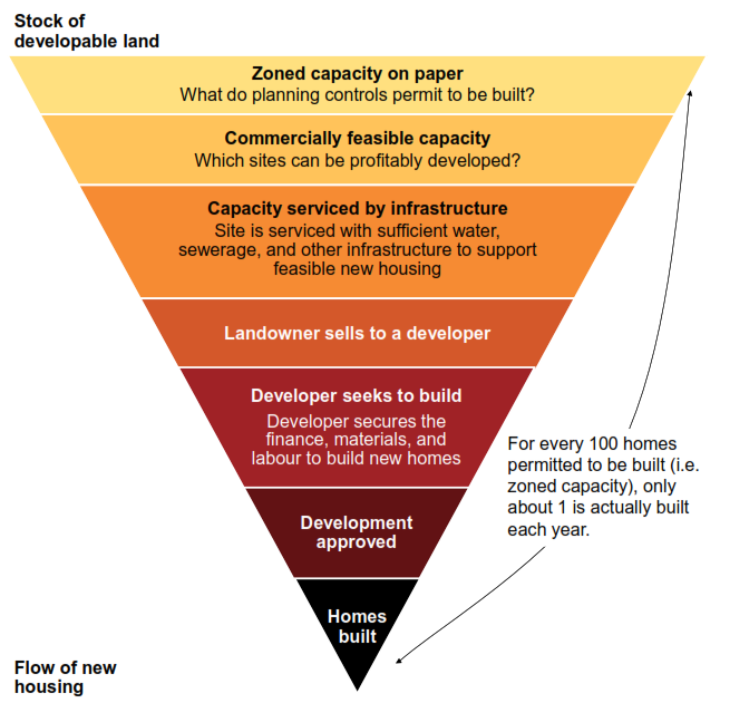
The Grattan Institute report More homes, better cities identified that for every 100 homes that is zoned for, only around 1 per year is built (see figure 2). If an area has a target of delivering 1900 homes over 5 years (Woollahra’s target for 2024-2029), the target will almost certainly not be met if sufficient additional zoned capacity is not provided to enable those 1900 homes to be built.
These factors mean that we need to zone for substantially more capacity than needs to be delivered in any given year. Just as this (or any other rezoning) will likely result in a lower number of dwellings being built, the alternative proposal by Woollahra for at most 3,600 homes would deliver far less again.
Figure 2: Ensuring a flow of new homes requires opportunities to build them. From Grattan Institute, More homes, better cities.
While Woollahra Council may claim to have met their previous set of housing targets, these were set unreasonably low. Sydney YIMBY categorically rejects meeting such low targets as evidence that there is limited demand for housing in an area. Full delivery in a constrained environment is evidence that the supply constraints are reached, not that demand is fulfilled, and it cannot be treated as such.
This rezoning will assist Woollahra in meeting its housing targets over the coming two decades, which will in fact reduce pressure on other less suitable areas in the LGA to deliver more housing.
The “luxury apartment” criticism and moving chains
This rezoning proposal has been criticised for providing housing that will be high in price. However again, the research is clear. When a new dwelling opens up at high price, a person who can afford that price will no longer compete further down the price scale.
The corollary to this is the creation of moving chains. By creating dwellings at a higher value, housing at a lower price point is vacated. This can then be occupied by someone who is no longer competing with people with higher purchasing power. This propagates down the chain.
It is possible to take the path some suggest, which is to limit the rezoning to protect existing low-cost housing. This choice requires the following decisions to be made:
We must ignore the displacement that has already occurred as housing costs spiraled out of control, across the LGA, across Sydney and across the country.
We accept that people who have little choice will likely be forced to live in housing that suffers from disinvestment (in order to keep rents low), or are subject to enormous subsidies to prevent them from being ejected anyway (due to increasing pressure from surrounding land values).
It is regrettable that some people will be displaced as a result of the rezoning. But this is best managed by implementing effective mitigating policies, such as prioritising existing tenants of low cost housing for new subsidised housing. Not building housing is only making the problem worse.
Affordable housing
Sydney YIMBY supports the decision to allow affordable housing contributions to be cashed out. This ensures that funding for housing can be allocated by appropriate agencies and directed as needed, without creating the distortions that arise from allocating floor space. We encourage Homes NSW and Woollahra Council to ensure that this is directed towards the people who need this housing most, i.e. those who are eligible for social housing.
Sydney YIMBY notes concerns that people currently occupying low cost housing in the area will be displaced, and we contend that cashing out affordable housing contributions and using it to support social housing ensures that those most in need of support receive it.
Demographics
Sydney YIMBY has undertaken a demographic analysis of the area to be rezoned, and has found that it is not only older than Greater Sydney (by a significant margin), it is older than the Woollahra LGA overall (see figure 3).
Figure 3: Sydney YIMBY analysis of demographic profiles over the 2011, 2016 and 2021 censuses for the area to be rezoned (derived from data at the SA1 level), the Woollahra LGA and the Greater Sydney Capital City Statistical Area. Source: ABS data
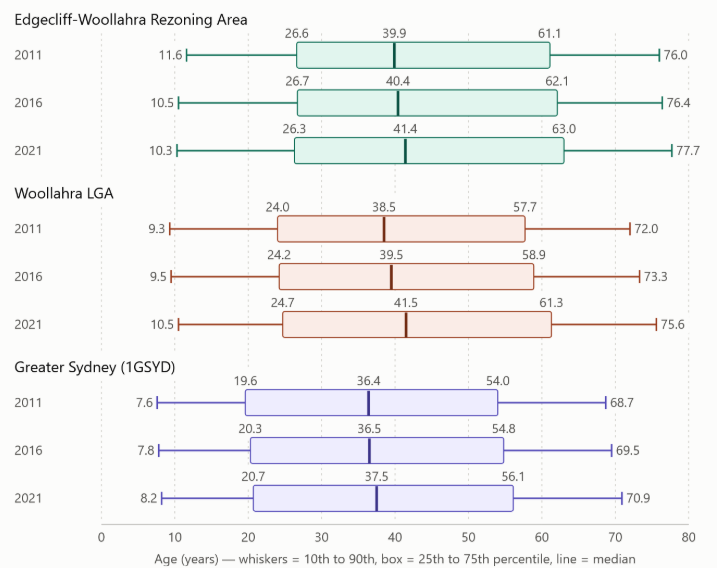
These demographic statistics are clear, the area to be rezoned has some characteristics closer to a retirement community than a vibrant, inner-city suburb. This is an area that will benefit from an influx of younger people, benefiting local businesses.
Heritage
Heritage protection has been one of the loudest arguments against densification, in Woollahra and more broadly. Sydney YIMBY takes a nuanced view of heritage. Fundamentally, we consider that heritage is worth preserving, but only where the costs are in alignment with the benefits. We don’t argue with the goal of preserving remarkable and interesting buildings for the benefit of the public. But not every mediocre old building needs to be preserved. It can be reasonably argued that preserving too many old buildings results in the value of heritage being diminished.
In 2017 SGS Economics and Planning undertook a study in Victoria, and it provided a very mixed view of the cost-benefit tradeoff for heritage, with large variations in community value for heritage. The community values “civic buildings such as hotels, train stations and courthouses substantially more than residential buildings or commercial buildings”. No comparable study is available for NSW, but there is no good reason to think the results would be any different.
Ultimately, heritage preservation (like all planning economics) is a question of tradeoffs. When we choose to preserve a building, or an area, it becomes unavailable, or very difficult to develop into more housing. This means that housing is either not delivered at all, or pushed somewhere else. Both of these outcomes have costs for us all as a society in the form of higher costs and displacement. Simply asserting that heritage provides some nebulous “value” does not eliminate these costs.
Sydney YIMBY considers that it is past time for a reckoning on heritage, and Woollahra is an excellent location to begin that reckoning. For more information on this see our 2025 submission to the draft NSW Heritage Strategy
